I am frequently asked this question, and my standard answer is that: it depends. It depends upon the type of process (slitting, printing, coating, laminating, die cutting, etc.), the range of products being run (rigid, extensible, deformable, etc), whether flying splices and/or turrets are involved, and incoming roll condition.
Dancers are very effective at minimizing web tension upsets due to out-of-round master rolls, rapid speed changes, indexing operations or any other process that introduces tension instability. The ability of a dancer system to absorb these upsets with the storage inherent in the system clearly offers some advantages for good closed-loop tension control. There are a few things to keep in mind when comparing or considering a dancer system for control.
- Dancers do not easily tell you what your actual web tension is. They are not typically calibrated in any meaningful units that can be readily converted or compared. This makes running a wide variety of products with any type of consistency more challenging.
- They are typically more mechanically complex, requiring more in terms of maintenance, and can be difficult to retrofit into a machine that does not already have one.
- They usually require more real estate in a machine which can be hard to come by
- Poorly designed dancer assemblies can create more tension problems than they are meant to solve. They need to be low-mass, have minimal inertia, and minimal friction. They also need to be designed carefully to accommodate expected loads.
- A good dancer system needs to be controlled by a robust, quality dancer control system.
Unwind Zone, Dancer and Load Cell Feedback

While load cells offer none of the advantages of web storage in the system, they do tell you exactly what the tension is, and this information can be used with a good control system to provide accurate, repeatable tension control that is simple to interpret for operators. This information can also provide meaningful feedback for production and quality control evaluation. Another advantage of a load cell system is that they are generally much easier to retrofit into an existing machine.
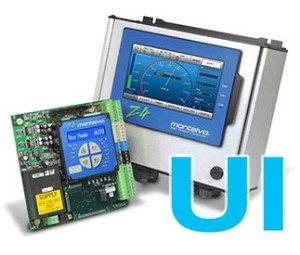
You could also take advantage of both systems by adding load cells to a dancer system so that you know what your actual web tension is. This provides for better process repeatability when running a wide variety of materials, and gives the operators some much-needed feedback for better consistency. As it is critical to have robust, quality dancer control system, Montalvo offers its Z4-UI dancer controller with tension indication which capitalizes on the benefits of a dancer and load cells while automatically controlling the tension